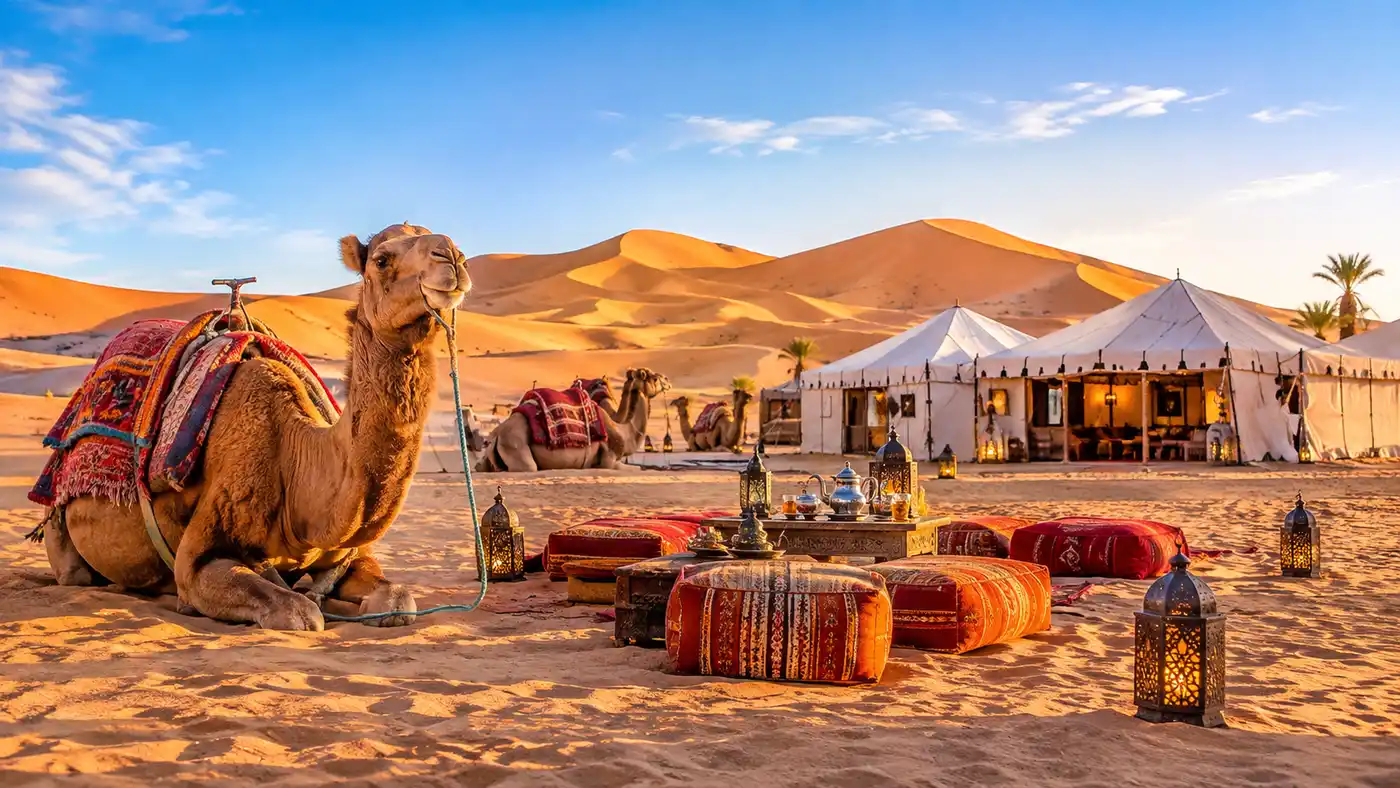
Sahara Desert Camping, Safaris, and Excursions
Sleeping under the stars in the Moroccan dunes is one of those trips people obsess over for years before actually booking it. The real experience of sahara desert camping tours rarely matches the manicured photos on social media. Your hair will be full of gritty dust within two hours, the tea is boiling hot even when it is 38 degrees outside, and the sheer silence at night makes your ears ring. Yet once you watch the horizon turn violet from the ridge of a 150-meter dune, every single hour spent cramped in a minivan over mountain passes evaporates from your memory.
Planning an escape to the dunes involves choosing the right route, knowing what camp standard suits your tolerance for roughing it, and sorting out your daily activities. This guide breaks down the logistics of heading south from the imperial cities, the truth about camel treks and 4x4 safaris, and how to get the most out of your time among the sand seas of Erg Chebbi and Erg Chigaga.
Book your sahara desert tour from marrakech experience:
Erg Chebbi or Erg Chigaga for Sahara Desert Camping Tours
Most travelers do not realize that Morocco has two distinct dune systems in the Sahara. Erg Chebbi sits right near the small village of Merzouga. It is dramatic, easily accessible by paved roads, and features towering orange dunes that rise straight out of the black rock desert. You can literally roll up to the edge of the sand in a compact rental car. Because of that convenience, Merzouga holds hundreds of camps, hotels, and quad rental shops. If you want high dunes, reliable running water, and quick access without hours of off-road kidney rattling, Chebbi is the obvious answer.
Erg Chigaga is wilder. Located past M'Hamid El Ghizlane, reaching these dunes requires at least two hours of serious off-road driving through dry riverbeds, salt flats, and rocky scrub. The dunes here are paler, slightly lower on average, but they cover a much larger area. You will not hear engines from nearby towns because there are no towns. If you crave genuine wilderness and do not mind a rougher ride, Chigaga delivers what Chebbi used to be thirty years ago.
Then there is Agafay. Plenty of tour operators advertise an "instant desert excursion" just forty minutes south of Marrakech. Agafay is a stone desert, not the sand-dune Sahara. It has beautiful barren white hills, trendy luxury camps, and great pool clubs, but not a single grain of orange sand. Do not book Agafay expecting Lawrence of Arabia dunes or you will be terribly disappointed.
| Destination | Transit Time from Marrakech | Dune Type | Landscape Character | Camp Atmosphere |
|---|---|---|---|---|
| Erg Chebbi (Merzouga) | 9 to 10 hours | High orange dunes (up to 150m) | Dramatic sand sea bordered by flat hamada | Lively, accessible, extensive amenities |
| Erg Chigaga (M'Hamid) | 9 to 11 hours (includes 4x4 track) | Rolling golden dunes (up to 120m) | Vast, untouched, remote wilderness | Isolated, quiet, rustic or boutique glamping |
| Agafay Desert | 45 minutes | Zero sand dunes (rocky stone desert) | Cracked clay ridges with Atlas Mountain views | Fashionable dinner camps, boutique pools |
Note: Winter nights in both Erg Chebbi and Erg Chigaga drop near freezing between December and February. Camp tents are rarely insulated, so pack thermal base layers and a wool beanie even if daytime temperatures feel pleasantly warm.
What to Expect on a Desert Safari Morocco
A typical safari day runs on solar time. You wake up around 5:45 AM when the light creeps through the canvas, scramble out into the freezing air, and hike to the nearest ridge to watch the sun ignite the sand. Breakfast follows: flatbread, sheep-milk cheeses, fried eggs spiced with cumin, and pots of sweet mint tea. During the heat of the day, everything slows to a crawl.
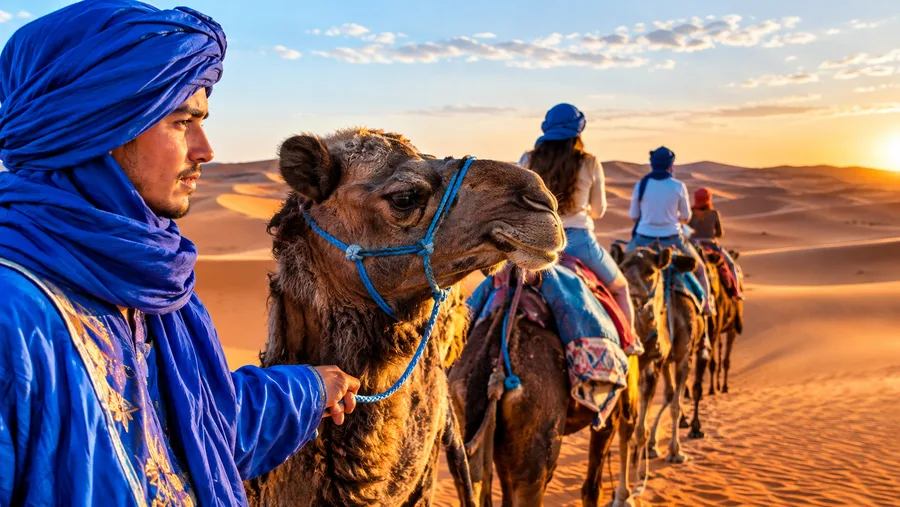
Camel riding sounds poetic until you do it for more than forty minutes. The rhythmic swaying is fine at first, but camel saddles are notoriously wooden and unforgiving on human hips. Most seasoned travelers take the camel ride out to camp for sunset, take their photos, and then opt for a 4x4 transfer on the way back out the next morning. Camels are majestic creatures with bizarre personalities, but your tailbone will thank you for keeping the ride brief.
In the late afternoon, the safari shifts gears. Your driver takes the Land Cruiser through the soft bowls between dunes, dropping into sand pockets that make your stomach float. If your trip is booked through luxury and private desert tours from Marrakech, the pace tends to be much more relaxed, giving you hours to read in shaded lounge tents before the evening drum circle starts around the campfire.
Local Berber camp staff usually play traditional gnawa and desert blues rhythms using metal castanets and heavy drums once dinner clears. It is loud, hypnotic, and completely unpretentious. By 10:00 PM, the fire dies down, the generator cuts out, and the darkness is so total you can see satellites drifting across the Milky Way with your bare eyes.
Planning Sahara Desert Excursions Marrakech Travelers Love
The road trip out from Marrakech is half the adventure. You cannot simply teleport to the Sahara, and attempting to drive it in a single day is a grueling, exhausting mistake. The journey winds across the High Atlas Mountains via the famous Tizi n'Tichka pass, reaching an altitude of 2,260 meters before tumbling down toward Ouarzazate.
The classic overland route breaks the drive into sensible chunks. Most operators run a standard 3-day Marrakech to Merzouga desert tour, spending night one in the Dades Valley or Skoura Oasis, night two out on the dunes, and day three driving back. The landscapes change wildly every hour: jagged pine-covered peaks give way to terraced apple orchards, which melt into arid red-rock canyons lined with lush date palm groves.
- Ait Benhaddou: An ancient fortified ksar made of clay and straw, famous from Gladiator and Game of Thrones, best explored around 9:00 AM before tour bus crowds arrive.
- Dades Gorge: A dramatic switchback mountain road clinging to sheer limestone cliffs, dotted with kasbahs built into the rock.
- Todra Gorge: A 300-meter-deep vertical canyon popular with rock climbers, where icy spring water runs through the gorge floor.
- Skoura Oasis: A quiet labyrinth of mudbrick ruins and living palm plantations irrigated by 800-year-old underground water channels.
Private sahara excursions from Marrakech allow you to stop wherever you want. You can pull over to buy roadside figs, wander through an ancient irrigation system, or grab lunch at a dusty roadside grill serving lamb tagine cooked over olive wood coals. Shared minibus tours are cheaper, usually costing around 90 to 130 euros per person, but you are stuck on someone else's rigid schedule and forced into tourist-trap souvenir stops.
Pro tip: If you are prone to motion sickness, take medication before leaving Marrakech. The road between the plains and the Tizi n'Tichka pass features over 80 kilometers of tight switchbacks and aggressive truck passing.
Book your sahara desert tour from marrakech experience:
Unmissable Things to Do in the Sahara Desert
Sitting on a dune rug doing nothing is genuinely wonderful, but there are plenty of active things to do in the Sahara desert once you shake off the transit fatigue. The terrain around the dunes is rich with geology, ancient history, and nomadic culture if you take the time to look past the sand.
Sandboarding is the easiest activity to try. Most camps have a few wooden boards leaning against the dining tent. Wax the base, hike up the slip face of a dune, step on, and hope for the best. Falling into soft, warm sand does not hurt, though you will be shaking sand grains out of your pockets for the rest of the week. Hiking up the dunes on foot without a board is surprisingly strenuous; for every step forward on soft sand, you slide back half a step. Early morning is the best time for hiking because the cool night air packs the sand surface firmly.
Quad biking and buggy rentals are wildly popular in Merzouga. An hour ripping across the open flats and cresting lower dunes gives a ridiculous adrenaline kick. Choose a guide who respects the environment and keeps away from active camping zones to avoid blanketing sleeping guests in exhaust fumes and motor roar.
- Fossil hunting near Rissani: Exploring ancient seabed beds where trilobites and ammonites are embedded in black marble slabs.
- Visiting the musicians of Khamlia: Listening to deep spiritual Gnawa music played by descendants of formerly enslaved people who settled in the desert.
- Nomad family tea visits: Drinking sweet herbal tea in hand-woven wool tents scattered across the rocky hamada plateaus.
- Stargazing without light pollution: Identifying whole constellations, shooting stars, and the planetary dust of the Milky Way.
Camp Styles on Sahara Desert Camping Tours
Not all desert camps are created equal. The market has split into very distinct tiers over the past decade, and knowing what you are paying for saves plenty of headaches.
Standard camps are traditional and basic. You sleep in black goat-hair tents, often with three or four cot beds tucked inside. Bathrooms are shared, usually located in a standalone cinderblock structure fifty meters from the sleeping area. Water pressure is minimal, and bucket flushes are standard. These camps feel authentic and communal, but if you wake up at 3:00 AM needing the toilet, you will be walking across cold sand in your sandals with a phone flashlight.
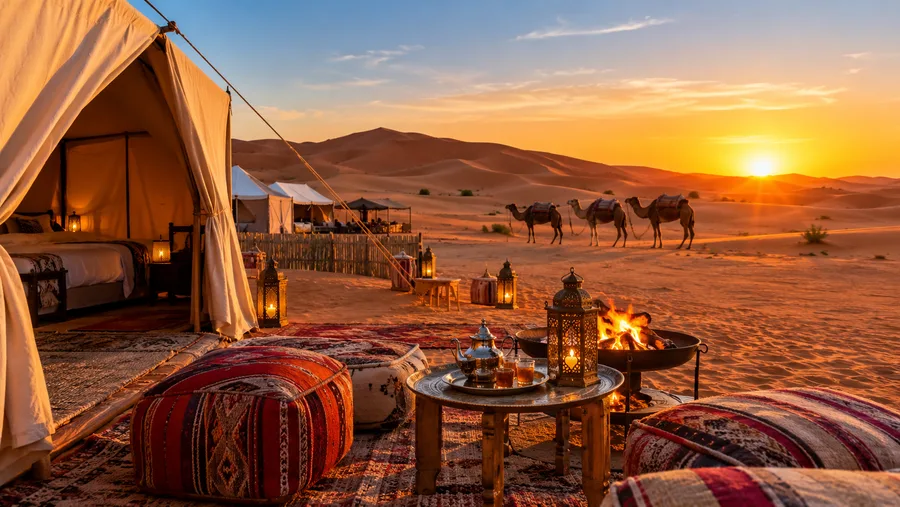
Mid-range and luxury desert excursions offer a radically different experience. The tents are expansive white canvas structures mounted on wooden decking, featuring king-sized beds, brass mirrors, woven kilim rugs, and private en-suite bathrooms with functioning flush toilets and hot showers. Solar panels charge deep-cycle batteries, giving you lighting and USB ports to recharge camera gear overnight. The dinner menus at high-end camps often rival boutique riads in Marrakech, serving slow-roasted mechoui lamb, spiced salads, and fresh fruit tarts.
Solo travelers and backpackers usually thrive in the standard camps where everyone eats together family-style around long tables. Couples, families with young children, and older travelers almost always prefer the comfort and privacy of an en-suite tent. The price difference is real - jumping from roughly 40 euros per night in a basic shared camp to 220 euros or more for a proper private glamping setup - but the ability to take a hot shower after a dusty camel trek is worth every penny to many.
Whichever camp style you choose, manage your expectations around technology. While some camps near Merzouga catch faint 4G cell signals from cell towers in town, remote camps in Chigaga have zero signal. Treat the journey as an enforced digital detox. Put the phone on airplane mode, leave the laptop at your hotel in Marrakech, and let yourself disconnect completely for forty-eight hours.
Frequently Asked Questions about sahara desert camping tours
How many days do you need for a Sahara desert excursion from Marrakech?
You need a minimum of three full days. A two-day trip to Merzouga means spending twenty hours inside a car over forty-eight hours, which is completely exhausting. If you want to visit Erg Chigaga comfortably, four days is much better because of the long off-road stretches.
Can you visit the Sahara Desert in the summer?
Mid-summer between late June and August brings daytime temperatures above 45 degrees Celsius (113 Fahrenheit). Most reputable camps shut down during July and August because the heat inside canvas tents is unbearable. October through April is the ideal window.
Are there dangerous animals or scorpions in the camps?
Desert vipers and scorpions do live in the Sahara, but they are nocturnal and hibernate during the cold winter months. In spring and autumn, staff sweep the camp areas daily. Keep your tent zipped closed at all times, shake out your boots before putting them on in the morning, and you will have no issues.
Quick Reference
- Merzouga (Erg Chebbi): 560 km from Marrakech, high orange dunes, 9-hour drive
- M'Hamid (Erg Chigaga): 510 km from Marrakech, wilder terrain, requires 4x4
- Peak season: October to November and March to April for mild weather
- Packing must-have: Headlamp, windbreaker, loose linen, thermal sleepwear
Book your sahara desert tour from marrakech experience:
My Take
If you are on the fence about taking a long trek into the dunes, make the trip happen. Yes, the drive over the Atlas Mountains is long and tiring, and yes, your clothes will smell like camel leather and wood smoke for days afterward. But watching the desert shadows stretch for miles as the sun dips below the horizon is something that stays with you forever. Book at least three days, pick a camp that matches your comfort expectations, and bring a good book for the long drive down.
Read more about sahara desert tour from marrakech.